Direct Private Mortgage Lender vs Middleman: What Toronto Brokers Should Look For
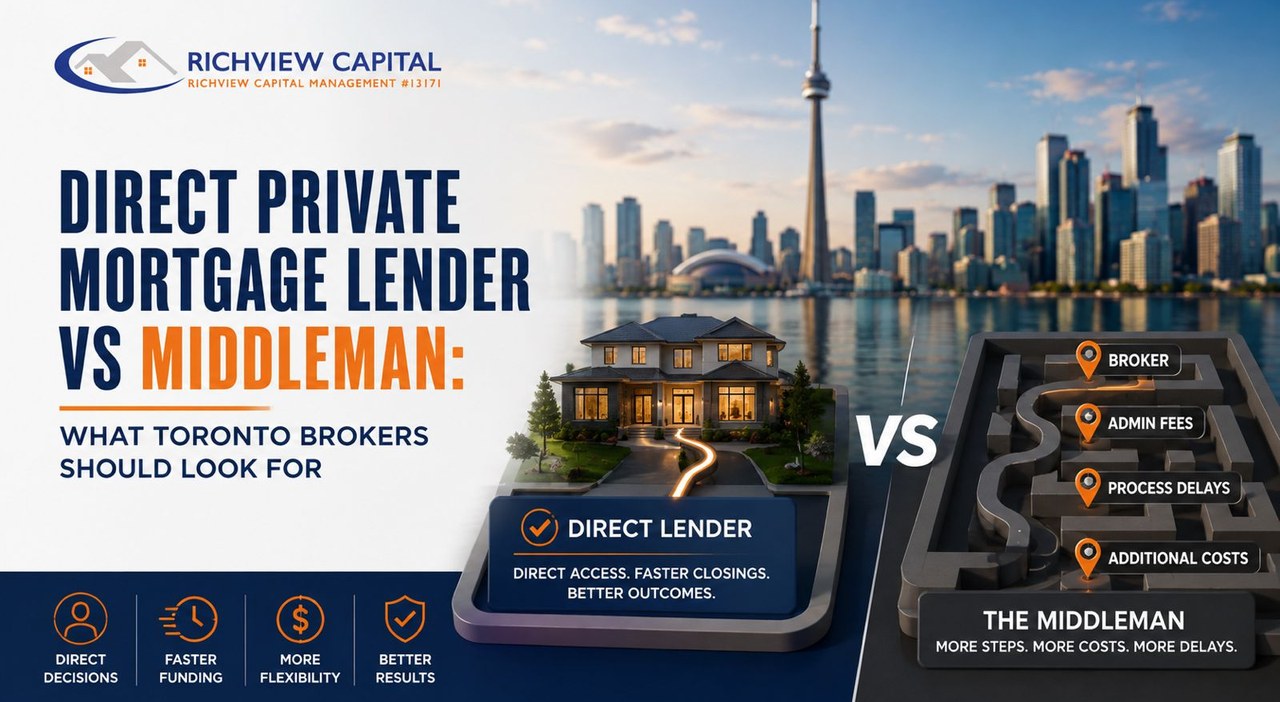
Every lender email in your inbox says the same thing: "direct private lender, fast closings, common-sense underwriting." Some of those senders hold capital and underwrite in-house. Others are intermediaries who will re-broker your file to the actual money, add a fee layer, and put a second approval between your client and closing. If you are a Toronto or GTA broker choosing a direct private mortgage lender for your alternative files, telling those two apart before you send the first deal is the single highest-leverage piece of due diligence you can do.
This guide is written broker to underwriter, with no fluff: what "direct" actually means, the five things to verify, the questions to ask on the first call, and the red flags that tell you a middleman is standing between you and the capital.
Why the direct-vs-middleman question decides how your deal goes
A direct private lender underwrites the file itself and funds from capital it controls, whether that is its own balance sheet or a pooled fund such as a mortgage investment corporation (MIC). The person who reviews your submission can commit, and the entity that issues the commitment is the entity that shows up on title.
A middleman looks similar from the outside. They take your submission, quote you terms, and may even issue something that reads like a commitment. But the money is somewhere else. They shop your file to individual investors, other brokerages, or lenders you could have approached yourself. That structure creates four predictable problems:
- A second approval you never see. The "yes" you quoted your client is conditional on an investor you have never met saying yes later.
- Stacked fees. The intermediary's fee sits on top of the actual lender's fee, and it usually surfaces late, in the commitment or, worse, in the instructions to the lawyer.
- Retrades. When the end investor balks at the appraisal, the rate moves or the LTV drops days before closing, and you are the one calling the client.
- Slow answers. Every question you ask gets relayed. Scenario responses take days because nobody in the chain can actually decide.
To be clear, intermediation is not inherently illegitimate. Co-brokering a complex file to a specialist with genuine lender relationships can serve a client well, and it is a regulated activity in Ontario. The problem is not that middlemen exist; it is not knowing which one you have when the marketing all reads the same.
The stakes are not small. According to the Financial Services Regulatory Authority of Ontario, Ontario saw 65,233 private mortgage transactions worth about $32 billion in 2024, and FSRA's mortgage brokering supervision plan keeps private mortgage suitability squarely in its sights. Every private file you place is one you may have to defend, and "I verified the lender was direct and disclosed all fees" is a much stronger note than "the quote came through a contact."
What "direct" actually means: in-house underwriting and in-house capital
"Direct" is two claims bundled together. Test them separately.
In-house underwriting
An in-house underwriter reads the file, prices the risk, and has authority to commit. Practically, that means conditions arrive once, early, instead of trickling in as each party in a chain reads the file for the first time. It means an exception (an unusual property, a credit story, a tight closing) gets decided by someone you can get on the phone, not relayed upward and answered by silence. When a lender advertises common-sense lending, in-house underwriting is the mechanism that makes it real. Without it, "common sense" is just a slogan waiting on someone else's credit committee.
In-house or committed capital
The second claim is about where the money sits. A MIC pools investor capital into a single fund that lends on its own book, so the capital is already raised before your file arrives. That is structurally different from a syndicator who "approves" your deal and then goes looking for investors to fill it. If the capital model is unfamiliar, it is worth five minutes to understand how a mortgage investment corporation works, because the structure answers the question that matters most to you: is the money there before the commitment is signed, or after?
A commitment from an entity with underwriting and capital under one roof is a decision. A commitment from an intermediary is a forecast.
Five things brokers should look for in a direct private mortgage lender in Toronto
1. Underwriting and capital under one roof
Ask who reviews the file and who funds it, and expect both answers to be the same company. Then verify rather than take it on faith. Check the lender's licence on FSRA's public registry (a MIC lending in Ontario through the broker channel will be licensed or work with a licensed administrator). Ask whose name registers on title for a typical deal; if the mortgagee on past deals is a rotating cast of individuals and numbered companies, you are probably looking at a syndicator. A genuine direct lender will answer these questions without flinching, because the answers are the pitch.
2. Real BDM access, with an underwriter behind it
A business development manager who buys you coffee is nice. A BDM who can get a scenario in front of an underwriter the same day is valuable. Test this before you have a live file: send a realistic scenario and time the response. What you want is a substantive answer (yes with terms, no with reasons, or a precise list of what is missing) within hours. What you do not want is "let me check with my lender partners," which is the middleman structure describing itself.
3. A broker-exclusive channel that never competes for your client
This is the item brokers check last and regret first. Some private lenders run a consumer-direct arm beside their broker channel, which means the client you introduce this year may be remarketed next year without you in the deal. Ask directly: do you solicit borrowers? At renewal, does the file come back through the originating broker? A lender committed to the broker channel treats your client as your client, on this deal and on every renewal and future advance that follows. Get the policy stated plainly, and note who honours it in practice; the GTA broker community is small enough that reputations are checkable with two phone calls.
4. A transparent rate sheet
A direct lender that knows its own cost of capital can publish rate and fee bands: first and second mortgages, by LTV band, with lender fees stated. You should be able to quote a realistic range to your client from the sheet before you submit, and the commitment should land inside it. Vague pricing ("rates from 5.99%, every deal is different") that firms up only after the client is committed is how stacked intermediary fees hide. Pricing context helps here too: with the Bank of Canada holding its policy rate at 2.25% as of its July 2026 announcement, private pricing has settled compared with the 2023 to 2024 peak, and a current view of private mortgage rates in Ontario gives you a benchmark to hold any lender's sheet against.
5. Renewal behaviour you can defend
Most private mortgages are one-year interest-only terms, so renewal is not an edge case; it is the plan. FSRA's 2024 private lending report found that three in five consumers discussed an exit strategy with their broker, up sharply from the year before, and regulators expect that conversation to be documented. So ask the renewal questions up front: What is the renewal fee? How much notice does the client get? If the exit is delayed (a sale that has not closed, a bank takeout waiting on a credit repair), does the lender work the file or move to enforcement? Private mortgage arrears remain low overall (FSRA reported a 0.20% delinquency rate in Q3 2024), but the lender's behaviour in the exceptions is what your client will remember, and what your Google reviews will reflect.
The cost of a middleman: a worked example
Suppose a broker has a client in Scarborough who needs a $300,000 second mortgage behind a $700,000 first on a home appraised at $1.4 million, to consolidate CRA arrears and consumer debt before a spring refinance. The numbers below are illustrative, not quotes, but the structure of the comparison is the point.
| Direct lender path | Middleman path | |
|---|---|---|
| Approval | Underwriter commits after reviewing the file once | "Approval" issued, then file shopped to end investors |
| Fee structure | Lender fee, disclosed on the rate sheet, plus your broker fee | End lender's fee, plus intermediary fee of 1% to 2% ($3,000 to $6,000), plus your broker fee |
| Timeline | Conditions issued once; closing driven by the client's documents | Extra days or weeks while investors review; conditions arrive in waves |
| Retrade risk | Low; the committing party is the funding party | Real; the end investor can reprice or walk before closing |
| Renewal | One counterparty with a stated renewal policy | Depends on an investor you and your client never chose |
On a $300,000 second, an extra 1.5% in stacked fees is $4,500 of the client's equity buying nothing but an introduction. That is the suitability conversation you want to avoid having in hindsight.
Questions to ask a private lender before sending the first deal
Lift these verbatim for the first call. A direct lender answers all of them quickly; a middleman gets vague around the capital and renewal sections.
Capital and approvals
- Who underwrites the file, and does that person have authority to commit?
- Where does the capital come from: your own fund or balance sheet, or investors sourced per deal?
- What entity appears as mortgagee on title?
- What is your FSRA licence number?
Process and timelines
- What does a complete submission look like, and how fast do you issue commitments on complete files?
- Who do I call with a scenario, and how fast do I get an underwriter's answer?
- Once committed, under what circumstances would terms change before closing?
Fees and pricing
- Can I see your current rate sheet, with lender fees by position and LTV?
- Are there any fees not on the sheet: administration, renewal, discharge, per-inspection draws?
Client protection and renewals
- Do you ever market directly to borrowers, or is your channel broker-exclusive?
- At renewal, does the file come back through me, and what is the renewal fee?
- What is your practice when a planned exit is delayed?
Once a lender has cleared this bar, the work shifts to presentation; a clean file gets clean terms, and our checklist on packaging a private mortgage submission covers what underwriters actually want in the package.
Red flags you are dealing with a middleman
| Signal | What it usually means |
|---|---|
| "Let me run this by my investors / lender partners" | The approval is not theirs to give |
| No published rate sheet; pricing firms up only after client commitment | Room being made for a stacked fee |
| Mortgagee on past deals is a changing list of individuals and numbered companies | Per-deal syndication, not a fund |
| Commitment arrives fast but conditions keep arriving for weeks | Each new reader of the file adds conditions |
| Cannot state a renewal policy | They will not be the counterparty at renewal |
| Reluctant to give an FSRA licence number or entity name | Stop entirely, and check the registry before any file moves |
None of these alone is disqualifying, but two or more together tell you the "direct lender" label is doing heavy lifting. For a broader look at the Toronto private lending landscape from the borrower's side of the table, including how rates and fees are typically structured in this market, see our honest guide to private mortgage lenders in Toronto and the GTA; it is useful ammunition when you are explaining a recommendation to a client.
Frequently asked questions
What is the difference between a direct private lender and a private mortgage middleman?
A direct private lender underwrites your file in-house and funds it from capital it already controls, such as a MIC's pooled fund. A middleman takes your file and re-brokers it to the actual source of capital, adding a fee layer and a second approval you cannot see or manage.
How can a broker verify that a Toronto private lender is actually direct?
Ask who underwrites, where the capital sits, and what entity registers on title, then check the lender's licence on FSRA's public registry. A direct lender gives consistent, immediate answers to all three; shifting or vague answers usually mean per-deal syndication.
Will a direct private lender compete with me for my client?
A genuinely broker-exclusive lender will not solicit your client directly, and renewals route back through you as the originating broker. Ask for the policy explicitly before the first deal, because some private lenders run consumer-direct channels beside their broker channel.
Why does it matter that the direct lender is a MIC?
A mortgage investment corporation lends from a pooled fund that is raised before your deal arrives, so commitments are backed by capital that already exists. That removes the gap between approval and funding where syndicated deals most often retrade.
What should a direct private lender's rate sheet include?
Rate and lender-fee ranges for first and second mortgages, broken out by LTV band, plus any standing charges such as renewal or discharge fees. You should be able to quote your client a realistic range from the sheet and see the commitment land inside it.
What happens at renewal with a direct private lender?
The lender is still the counterparty, so renewal terms, fees, and notice periods follow the policy it stated up front, and the file comes back through the originating broker. That is also where exit-strategy planning pays off, since regulators increasingly expect brokers to document how a private mortgage will be repaid or replaced.
Send your next Toronto file to a direct MIC lender
Everything above is a checklist you can run on any lender, including us. Richview Capital is a licensed Ontario mortgage investment corporation (FSRA licence #13171) that lends directly from its own fund, underwrites in-house, and works through the broker channel across Toronto, the GTA, and Ontario. Your client stays your client: we are a lender to the broker community, not a competitor inside it.
If you have a scenario, test us the way this article suggests: send it over and see how fast you get an underwriter's answer. Connect with our team through the Richview Capital broker page to introduce yourself, ask for our current rate sheet, and send your first file with a clear picture of exactly who is on the other end of it.
Next steps: Brokers · Submit a Deal · FAQ
Richview Capital MIC is a licensed Mortgage Investment Corporation (Mortgage Administrator License #13171). This article is educational information for Ontario mortgage brokers, not legal, financial, or tax advice. Rates, fees, LTV limits, and approvals vary by file and underwriting, and published ranges are subject to change and are not an offer of credit.