Fast Private Mortgage Closing in Ontario: The Same Week Funding Checklist for Brokers
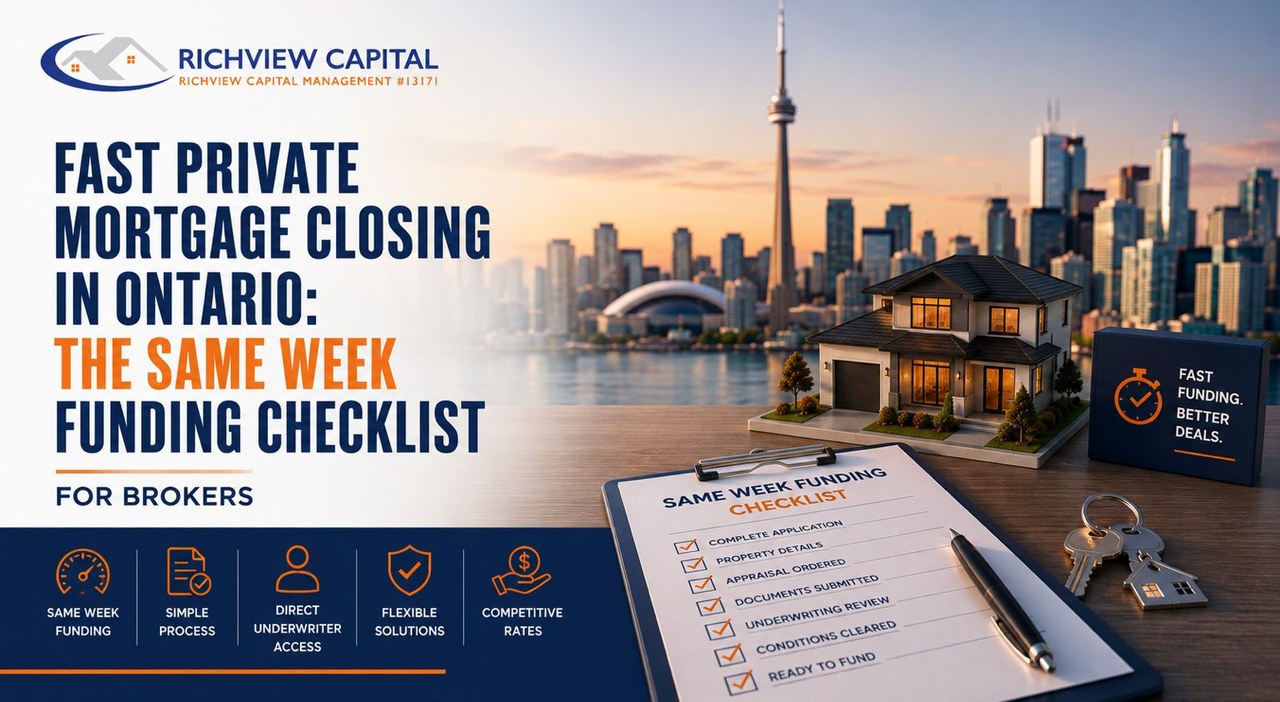
Every private lender in Ontario claims fast closings. You have heard "approved in 48 hours" enough times to know it usually means approved in 48 hours, funded whenever the payout statement shows up. For a broker with a time-sensitive file, fast private mortgage closing in Ontario comes down to three questions: what makes same week funding physically possible, what quietly kills it, and which deal types can realistically hit the date you are about to promise your client. Here is the breakdown, from the underwriting side of the desk.
The honest answer: how fast a private mortgage can actually close
On the right file, a private mortgage in Ontario can fund in 2 to 5 business days. The realistic norm, even with a motivated lender, is 5 to 10 business days. And some files will never close inside a week no matter who gets them, because the constraint is not the lender: it is a payout statement sitting in a bank's discharge queue, an appraiser who cannot get access, or a lawyer who has not been retained yet.
Private lending is a large, established channel here: per FSRA's Private Residential Mortgage Lending in Ontario Report 2024, private lenders funded roughly $32 billion across 65,233 Ontario mortgages in 2024. Plenty of those deals closed fast, and they closed fast because the workstreams ran in parallel from day one, not because a website promised 48 hours.
Commitment speed and funding speed are different things. A direct lender with in-house underwriting can issue a commitment on a clean package within hours. Funding is a logistics problem involving the appraiser, the title insurer, two law offices, and the existing lender being paid out. Your job, if you want the fast date, is to remove every excuse those parties will have to sit still.
What same week funding actually requires
Think of a private mortgage closing as five lanes that must all reach the finish line by Friday:
- Underwriting: application to signed commitment
- Valuation: appraisal ordered, completed, reviewed
- Title: search, title insurance, any cure work
- Legal: lender's counsel instructing, borrower's counsel signing and registering
- Payout: statements from every existing lender, current to the closing date
None of these lanes can start until the lender has the file, and several cannot start until the borrower acts. The biggest speed lever in the process is therefore the quality of your submission: a complete package lets a lender green-light all five lanes on day one instead of spending two days asking for documents. One slow lane resets the whole clock, and the slow lane is almost never underwriting.
The same week funding checklist for brokers
Run this before you tell any client "this week."
1. Send a complete submission, not a teaser
A two-line email with an address and a credit score is an invitation to trade emails for three days. A fundable package includes the full application, a current credit bureau, mortgage statements for every existing charge, property details with photos, the requested amount and term, a clear reason for funds, and a stated exit strategy. FSRA's 2025-26 mortgage brokering supervision plan has sharpened scrutiny of private deals, so the suitability documentation has to exist anyway; build it once, at submission, and you buy speed and compliance with the same effort. Our full private mortgage deal submission standard covers packaging in detail; this article focuses on the closing clock.
One more habit that pays for itself: disclose the ugly facts up front, whether that is a consumer proposal, CRA arrears, a pending separation, or a tenant who will not allow access. An underwriter can structure around almost anything on Monday. Discovering it Thursday is how commitments get repriced or pulled.
2. Solve the appraisal on day one
Valuation is the lane brokers most often leave idle. The options, fastest to slowest:
- Transfer a recent appraisal. If a full appraisal was completed in the last 60 to 90 days, many private lenders will accept it re-addressed with a reliance letter from the appraiser. Same day, minimal cost.
- Desktop or drive-by report. On lower-LTV urban files with good comparable data, some lenders will accept a desktop or exterior-only report, often within 24 to 48 hours.
- Full appraisal with a rush fee. In Toronto and most of the GTA, a rushed full appraisal can usually be inspected and delivered inside 1 to 3 business days if access is arranged immediately. Rural, unique, and income-producing properties take longer.
The broker's move: confirm on day one which option the lender will accept, then solve access the same hour. Tenanted properties, lockboxes, and out-of-town owners are appraisal killers; if the borrower cannot produce a key and a contact, the week is already gone.
3. Let title insurance close the gaps
Title insurance is the quiet workhorse of fast Ontario closings. A lender policy from insurers such as FCT, Stewart Title, or Chicago Title lets the deal proceed without an up-to-date survey, covers many minor defects that would otherwise need curing before funding, and provides gap coverage between the release of funds and electronic registration. Problems that once took weeks of cure work become insurable risks handled inside a single closing.
Know its limits, though. Title insurance does not make writs of execution disappear, does not cure a spouse's undisclosed interest in a matrimonial home, and does not pay out someone else's registered mortgage. Those still require execution searches against every name on title, spousal consent under Ontario's Family Law Act, and clean payout arrangements. Flag any of them in your submission notes so the lawyers see them Monday, not Thursday.
4. Get the borrower's lawyer moving early
In a rush closing, the borrower's lawyer is the most common bottleneck, simply because nobody calls them until the commitment is signed. That office has real work to do: verify identity to FINTRAC standards, review the commitment, obtain independent legal advice signatures, collect spousal consents where required, and be ready to register the charge electronically through Teraview and account for funds.
Have the borrower retain and pay their lawyer the same day the commitment is signed, and confirm the lawyer can actually act this week. A sole practitioner in trial, or a firm that will not take a rush private deal, costs you two days you do not have. Remember closing day mechanics too: registration and wires have real cutoff times, and a closing that is "done except the wire" at 4:30 p.m. is a Monday closing.
5. Order payout statements before you are asked
If the new mortgage pays out anything, the payout statement is the item most likely to decide your funding date, because it is the one document controlled by a party with zero interest in your timeline. Chartered banks commonly take several business days to a week or more to issue payout or discharge statements, and statements must be current, with per diem interest, to the actual closing date. Private lenders being paid out are usually faster but add their own per diem and discharge fees.
Get a signed payout authorization from the borrower with the application, and have the request into every existing lender the day the file is submitted. Confirm property tax status, ask directly about CRA debts and liens, and on condos, order the status certificate immediately. An undisclosed second mortgage surfacing on the title search is the classic Thursday-afternoon deal killer.
What genuinely causes delays
Ranked by how often they actually move funding dates:
- Incomplete submissions. Every missing document is a round trip. Two round trips is a lost day.
- Payout statement lag. The bank's discharge department does not do rush.
- No lawyer retained. The borrower "has a guy" who has not been called.
- Appraisal access. Tenants, lockboxes, sellers who will not answer.
- Title surprises. Executions, construction liens, condo status certificate issues, an extra charge nobody mentioned.
- Missing signatures. A spouse on title, or with a matrimonial home interest, who is out of the country.
- Wire and registration cutoffs. The deal was funded, technically, at 5:10 p.m.
- Retrades from misdisclosure. The file that changes underneath the commitment gets re-underwritten, and the clock restarts.
Notice what is not on the list: the underwriting decision. On a properly packaged equity deal, the yes or no is the fast part.
Realistic private mortgage timelines by deal type
Assume a complete submission on day one and a cooperative borrower. These are working ranges, not guarantees; your lender should tell you where a specific file lands before you promise a date.
| Deal type | Realistic range | Governing constraint |
|---|---|---|
| First mortgage, urban single family, clean title | 3 to 7 business days | Appraisal and lawyer readiness |
| Second mortgage behind a bank first | 3 to 7 business days | Appraisal; first mortgage statement |
| Refinance with full payout of existing lender | 5 to 10 business days | Bank payout statement turnaround |
| Power of sale or eviction rescue | 3 to 10 business days | Lawyer coordination and current arrears figures |
| Condo | Add 1 to 3 days | Status certificate |
| Rural, acreage, or unique property | 7 to 15 business days | Appraiser availability and comparables |
| Construction or renovation draw deal | 10 business days plus | Budget review, inspections, draw setup |
Second mortgages in Ontario are often the fastest category in practice: smaller dollars, no payout of the first, and equity math that is quick to verify. At the other end, private construction financing is never a same week product on the first advance, because budgets and draw schedules take real diligence. Speed is not free anywhere on this table either: rush appraisals, per diem interest, and short-notice legal work all land in the client's cost of funds, worth reading alongside current private mortgage rates in Ontario.
Why a direct lender closes faster than a lender-shopping layer
Structure explains most of the speed differences between "fast" lenders. A brokerage or matching service that shops your file to dozens of private lenders adds a layer: your package gets summarized, circulated, and re-underwritten by whoever bites, and if the capital comes from syndicating individual investors, funding waits on those investors moving money. A direct mortgage investment corporation pools investor capital in advance and lends it under one credit policy, so one underwriting desk issues the commitment and the funds are already in the corporation. Understanding how a mortgage investment corporation works makes the speed question concrete: fewer decision makers, no capital scramble, one set of instructions to counsel.
The market context rewards brokers who get this right. With the Bank of Canada's policy rate holding at 2.25% since late 2025, more clients can graduate back to institutional lending, and FSRA's 2024 data shows 60% of private mortgage consumers discussed an exit strategy with their broker, up from 43% a year earlier. Private deals in 2026 are shorter, more purposeful, and more time-sensitive. A February 2026 survey of Canadian mortgage brokers found brokers nearly evenly split between wanting fast approvals, flexible policies, and competitive pricing from private lenders, and many report not getting them. The fix on speed is structural: pick direct lenders, and feed them complete files.
A same week close, hour by hour
A hypothetical, to make the checklist concrete. Suppose a broker's client in Mississauga has a detached home, a bank first mortgage, and a CRA bill due in ten days. The broker submits a complete second mortgage package Monday at 9 a.m.: application, bureau, first mortgage statement, photos, tax bill, signed payout authorization, and refinance at renewal as the exit.
- Monday: The underwriter issues a commitment by early afternoon. The lender accepts a rushed exterior appraisal, ordered with access arranged for Tuesday morning. The borrower retains a lawyer and signs the commitment that evening.
- Tuesday: Appraisal inspection at 9 a.m. Lender's counsel opens the file, runs title and execution searches, and orders title insurance. CRA payout figures are confirmed.
- Wednesday: Appraisal delivered and value confirmed. Instructions go to both law offices. The borrower's spouse, who is on title, is booked to sign Thursday.
- Thursday: Borrower and spouse complete ILA and sign the mortgage package. Funds are requisitioned for Friday.
- Friday: Charge registered through Teraview before noon, funds wired inside the cutoff, CRA paid directly from lawyer's trust. Funded in five business days.
Every step of that timeline was boring, and that is the point. Same week funding is not heroics; it is the absence of surprises.
FAQ
Can a private mortgage really close in 48 hours in Ontario?
Occasionally, yes: typically a smaller second mortgage on an urban property where the appraisal is waived or transferred, both law offices prioritize the file, and nothing needs a payout statement. Treat 48 hours as the rare best case, not a planning assumption; 2 to 5 business days is the honest fast lane for a clean file.
Do all private mortgage deals need a full appraisal?
No. Depending on the lender, LTV, and property, options include transferring a recent appraisal with a reliance letter, a desktop or drive-by valuation, or a rushed full report. Unique, rural, and higher-LTV properties almost always need a full appraisal, so confirm on day one.
How long do payout statements take from the big banks?
Commonly several business days, and sometimes more than a week, since discharge departments work their own queue. The statement must also be current to your closing date with per diem interest. A signed payout authorization submitted with the application starts the clock as early as possible.
What should a broker include in a rush private mortgage submission?
The full application, current credit bureau, statements for every existing mortgage, property details and photos, reason for funds, requested amount, and exit strategy, plus honest disclosure of anything unusual on title or credit. A complete package lets a direct lender commit the same day and start every closing workstream at once.
Does title insurance speed up a private mortgage closing?
Yes, materially. A lender title insurance policy removes the need for a new survey, covers many minor title defects that would otherwise need curing, and bridges the gap between funding and registration. It does not cure executions, undisclosed charges, or missing spousal consents, so surface those early.
What is the fastest private deal type for same week funding?
Usually a modest second mortgage behind a bank first on an urban single family home with obvious equity: no payout, quick valuation, simple title. Refinances paying out a bank mortgage, condos waiting on status certificates, rural properties, and construction draws all carry built-in delays no lender can fully compress.
Have a file that cannot wait? Send it to a direct lender
Everything above comes down to one principle: same week funding happens when a complete file meets a lender that can decide and fund without asking anyone's permission. Richview Capital is built for exactly that: a licensed Ontario mortgage investment corporation (MIC #13171) lending its own pooled capital across Toronto, the GTA, and Ontario, with underwriting done in-house and every deal sourced through the broker channel.
That structure is what brokers should expect from a direct MIC: a straight answer from the people who actually make the decision, commitments that hold, and a closing process run in parallel from the day your package lands, with no lender-shopping layer between your file and a decision.
If you have a time-sensitive deal, or simply want a direct lender on your roster before the next one shows up, connect with our team through the Richview broker page and see how your next submission runs.
Next steps: Brokers · Submit a Deal · FAQ
Richview Capital MIC is a licensed Mortgage Investment Corporation (Mortgage Administrator License #13171). This article is educational information for Ontario mortgage brokers, not legal, financial, or tax advice. Rates, fees, LTV limits, and approvals vary by file and underwriting, and published ranges are subject to change and are not an offer of credit.