Interest Only Mortgage in Canada: How It Works, the Math, and When It Makes Sense
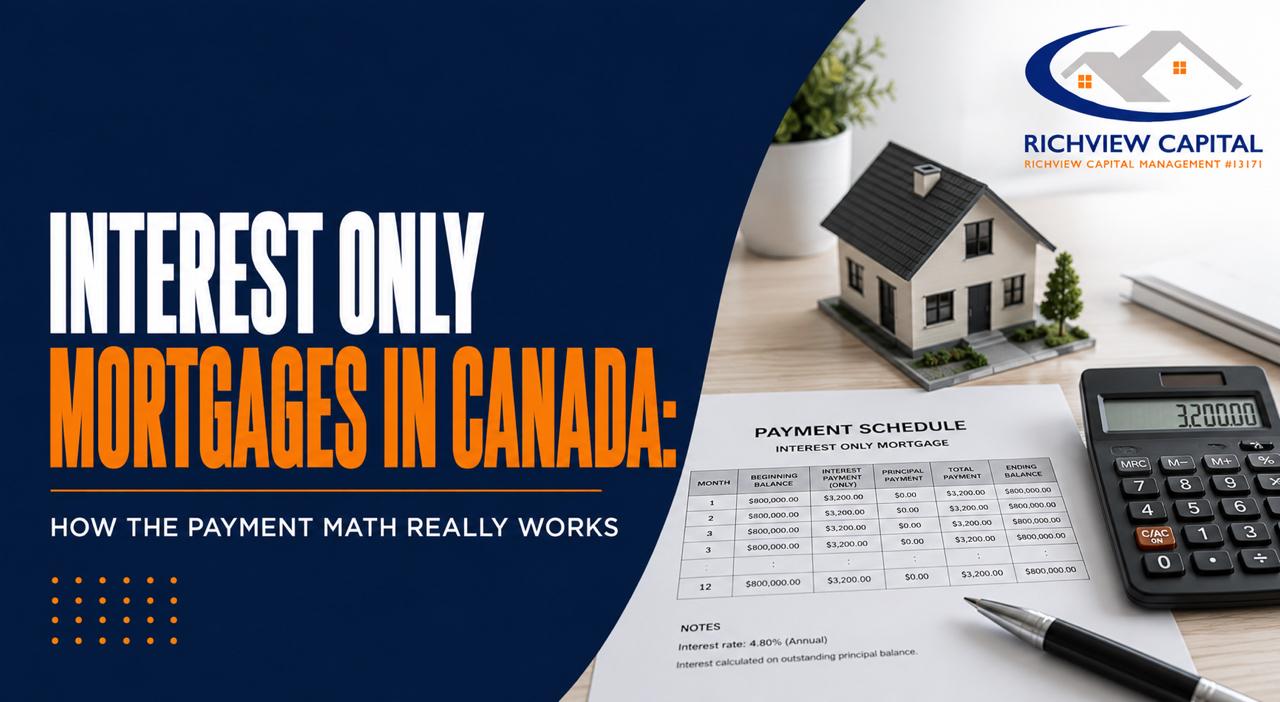
An interest only mortgage in Canada does one thing very well: it cuts your monthly payment to the minimum the debt allows. For the right borrower at the right moment, that is exactly the point. For the wrong borrower, it is an expensive way to stand still. This guide explains how interest-only payments work, who actually offers them in Canada (mostly private lenders, plus one bank product most people overlook), what the payment math looks like next to a normal amortizing mortgage, and when the structure earns its keep.
What an Interest-Only Mortgage Is (and What It Is Not)
With a standard Canadian mortgage, every payment is split between interest and principal. Over a 25-year or 30-year amortization, the principal portion grows and the balance falls to zero.
An interest-only mortgage removes the principal portion. Each month you pay only the interest that accrued on the balance. At the end of the term, you owe exactly what you borrowed. Nothing has been repaid, and nothing was scheduled to be.
Two clarifications matter:
- It is not a permanent structure in Canada. Unlike some U.S. products, Canadian interest-only arrangements are short-term tools, typically one-year to two-year private terms or the revolving portion of a home equity line of credit. No mainstream Canadian lender offers a 25-year interest-only residential mortgage.
- It usually does not forbid principal payments. Most interest-only loans let you pay principal voluntarily, subject to the loan agreement. The structure sets the minimum obligation, not a ceiling.
Who Offers Interest-Only Mortgages in Canada?
Walk into a major bank and ask for an interest-only mortgage on your home, and the answer will almost always be no. Federally regulated lenders underwrite residential mortgages as amortizing loans. In practice there are two real routes.
The HELOC route
A home equity line of credit is the one widely available, federally regulated product with interest-only minimum payments. You draw what you need, and the minimum monthly payment is typically the interest on the outstanding balance, as the Financial Consumer Agency of Canada explains.
The catch is access. Under OSFI's Guideline B-20, the revolving interest-only portion of a HELOC is capped at 65 percent of your home's value, with anything above that (up to 80 percent) required to amortize. You also need to qualify under full bank underwriting, including the stress test, which screens out many of the borrowers who most need payment flexibility. We cover the product in more depth in our guide to HELOCs and home equity loans in the GTA.
Private lenders and MICs
The main home of the true interest-only mortgage in Canada is the private lending market: mortgage investment corporations (MICs), private lending funds, and individual private lenders, arranged through licensed mortgage brokers.
This market is small relative to the banks but growing quickly. CMHC's Residential Mortgage Industry Report (Spring 2026 edition) found that mortgage investment entities held about 1.3 percent of outstanding Canadian mortgages but accounted for 4.7 percent of newly originated mortgages in Q3 2025, and that the 25 largest firms managed $11.5 billion in assets, up 8.8 percent year over year. CMHC also notes that these loans commonly feature interest-only payments and terms under a year. In other words, interest-only is not an exotic add-on in private lending. It is the default design.
In Ontario, private mortgages must be arranged through brokers and agents licensed by the Financial Services Regulatory Authority, which publishes plain-language consumer guidance on private mortgages, including required disclosures of rates, fees, and terms. For a full picture of how this market works, see our guide to private mortgages in Ontario.
Interest-Only vs Amortizing Payments: The Math
The appeal of an interest only mortgage in Canada is a cash-flow number, so it deserves real numbers. The examples below are hypothetical worked examples, rounded to the nearest dollar. Amortizing payments use standard Canadian semi-annual compounding. For context, the Bank of Canada's policy interest rate sits at 2.25 percent as of August 2026, and the major banks' prime rate is 4.45 percent.
Example 1: same loan, two payment structures. Suppose you owe $500,000 at 5.00 percent.
| Structure | Monthly payment | Principal repaid per month |
|---|---|---|
| Interest-only | $2,083 | $0 |
| Amortizing, 25 years | $2,908 | About $825 at first, rising over time |
The interest-only payment is roughly 28 percent lower, freeing about $825 per month. Flip it around and you see the payment shock in reverse: moving from interest-only to a 25-year amortization on this loan means a payment increase of about 40 percent.
Example 2: a private first mortgage. Private money costs more than bank money. Suppose a borrower takes a $500,000 private first mortgage at 9.00 percent, interest-only, on a one-year term. The payment is $3,750 per month. If that same loan had to amortize over 25 years, the payment would be about $4,140. The interest-only structure saves roughly $390 per month, but the more important comparison is usually against the alternative of no financing at all, because these are loans banks would not have made.
Example 3: an interest-only second mortgage. Suppose a homeowner adds a second mortgage in Ontario of $100,000 at 11.00 percent, interest-only. That costs about $917 per month. Consolidating $100,000 of credit card debt at around 20 percent interest would cost roughly $1,667 per month in interest alone, so even at a double-digit mortgage rate the monthly carry can drop sharply.
The three-year picture
Monthly savings are only half the story. Extend Example 1 across 36 months:
| After 3 years | Interest-only | Amortizing, 25 years |
|---|---|---|
| Total paid | $75,000 | $104,684 |
| Interest paid | $75,000 | About $71,930 |
| Principal repaid | $0 | About $32,750 |
| Balance remaining | $500,000 | About $467,250 |
The interest-only borrower paid $29,684 less in total, but also paid slightly more pure interest and ended the period with about $32,750 less equity. That is the honest trade: lower payments now, in exchange for a balance that does not move. Interest-only is a liquidity tool, not a savings plan.
When Interest-Only Is the Right Tool
Because the balance never shrinks on its own, an interest-only mortgage makes sense when the situation is temporary and the low payment buys something concrete. These are the use cases where private interest-only lending does work banks will not touch.
Bridge periods
You bought your next home before your current one sold. An estate needs to pay out beneficiaries before probate assets are liquid. A separating couple needs one spouse bought out before the house is refinanced or sold. In each case there is a known event on the horizon that repays the loan, and the goal is simply to carry the property until then.
As a hypothetical, a $300,000 private bridge at 9.50 percent interest-only costs $2,375 per month. Carry it for eight months and the total interest is about $19,000, plus fees. Against a forced sale, a collapsed purchase, or a stalled estate, that can be a rational price for time.
Renovations and construction
A property mid-renovation often cannot get bank financing at all: unfinished kitchens, open permits, or a purchase where the value story only works after the work is done. Private interest-only loans carry the property through the messy middle, keeping the monthly burn as low as possible while the budget goes into the build. Once the work is complete and the property appraises, the borrower refinances to cheaper long-term money. The same logic drives construction financing in Ontario, where interest-only draws are the standard structure during the build.
Investors and cash flow
For rental investors, the mortgage payment is the largest line on the operating statement, and only the interest portion is a true cost; the principal portion is forced savings. An interest-only structure strips the payment down to actual cost, which can turn a property that is cash-flow negative on paper into one that carries itself during a value-add phase, a lease-up, or a flip. Interest on money borrowed to earn investment income is also generally deductible, which is worth confirming with an accountant for your situation.
The discipline that has to come with this: the structure improves cash flow, not returns. If the deal only works because no principal is being repaid, it is a thin deal.
Income gaps and irregular income
Self-employed borrowers with strong equity but lumpy or hard-to-document income, contractors between projects, and homeowners recovering from a credit event often fail bank underwriting for reasons that have nothing to do with the property. A one-year interest-only private term can hold the payment down while income stabilizes or two years of financials accumulate, after which the borrower refinances with a mainstream lender. Our guide to mortgage options for self-employed borrowers covers that path in detail.
The Risks: What You Trade for the Lower Payment
Every one of these deserves weight before you sign.
- Your payments build no equity. After a one-year interest-only term you owe every dollar you borrowed. Any equity growth comes from the market or from voluntary principal payments, not from the schedule.
- Payment shock is real. In Example 1 the jump from interest-only to a 25-year amortizing payment was about 40 percent. Budget for the after, not the during.
- Short terms mean renewal risk. Private interest-only terms commonly run 12 months. If your exit has not materialized, you are renewing, extending, or refinancing, each with costs, and on the lender's read of the file at that time.
- Private money carries higher rates and fees. Private first mortgages in Ontario commonly price well above bank rates, with second mortgages higher again, plus lender and broker fees that in Ontario must be disclosed under FSRA rules. Always compare the all-in cost, not the rate alone.
- Falling values cut both ways. With no principal repayment, a drop in property value comes straight out of your equity. Conservative loan-to-value at the start is your buffer.
Qualifying: Bank Route vs Private Route
The two routes qualify you in different ways.
The bank route (HELOC). You qualify on income, credit, and the federal stress test, which requires proving you can afford payments at the greater of 5.25 percent or your contract rate plus 2 percentage points. The revolving interest-only portion is capped at 65 percent of the home's value. Strong files get prime-plus pricing; weaker or less documentable files get declined.
The private route. Private lenders underwrite primarily on the property and the plan: appraised value, location and condition, total loan-to-value (often capped around 75 to 80 percent, and lower on less marketable properties), and above all the exit strategy. Income and credit still matter, but as context rather than gatekeepers.
That last item is the section most guides skip. A private interest-only mortgage should never be funded without a written answer to one question: how does this loan get repaid? There are only three exits: sell the property, refinance to a cheaper lender, or renew the private term. A good broker or lender stress-tests the exit before funding, because a low payment with no exit is not flexibility. It is a countdown.
Frequently Asked Questions
Can you get an interest-only mortgage in Canada?
Yes, but availability is narrow. The main sources are private lenders and mortgage investment corporations, which commonly structure loans as interest-only with terms around a year, and HELOCs from banks and credit unions, which allow interest-only minimum payments on the revolving portion.
Do the big banks offer interest-only mortgages?
Not as stand-alone residential term mortgages. The closest bank product is the HELOC, where OSFI rules cap the interest-only revolving portion at 65 percent of the home's value and full income and stress-test qualification applies.
Is a HELOC the same as an interest-only mortgage?
No, but it behaves like one if you pay only the minimum. A HELOC is revolving credit secured by your home with interest-only minimum payments, while a private interest-only mortgage is a fixed-amount term loan. The HELOC is usually cheaper but much harder to qualify for.
What does an interest only private mortgage cost?
Expect a rate meaningfully above bank pricing, with first mortgages typically in the high single digits to low double digits and second mortgages higher, plus lender and broker fees. In Ontario, all rates and fees must be disclosed to you by an FSRA-licensed broker before you commit.
What happens at the end of an interest-only term?
You still owe the full original balance, so you need an exit: sell the property, refinance with a bank or other lender, or renew the private term. The exit should be planned before the loan is funded, not at maturity.
Can I pay down principal on an interest-only mortgage if I want to?
Usually yes. Most interest-only loans set interest as the minimum payment but allow voluntary principal prepayments, subject to the terms of the specific agreement. Confirm the prepayment provisions before signing.
Talk Through the Numbers Before You Commit
Interest-only lending is most of what we do. Richview Capital is a Canadian mortgage investment corporation that provides alternative mortgage financing, including interest-only private first and second mortgages across Ontario, and connects investors with secured, real-estate-backed lending opportunities. Bridge periods, renovations, investor cash flow, and income gaps are the files we see every week, so we can tell you quickly whether an interest-only structure fits your situation or whether a different tool would serve you better.
If you are weighing an interest-only mortgage, the useful next step is a short conversation about the property, the numbers, and the exit. Contact Richview Capital and we will walk through the math with you, with every rate and fee on the table before you decide anything.
Next steps: Borrowers · Speak With Our Team · FAQ
Richview Capital MIC is a licensed Mortgage Investment Corporation (Mortgage Administrator License #13171). This article is educational information for Ontario homeowners, not legal, financial, or tax advice. Rates, fees, LTV limits, and approvals vary by file and underwriting, and published ranges are subject to change and are not an offer of credit.