MIC vs Private Lender vs Syndicated Mortgage: Where Should a Broker Place a Private Deal in Ontario?
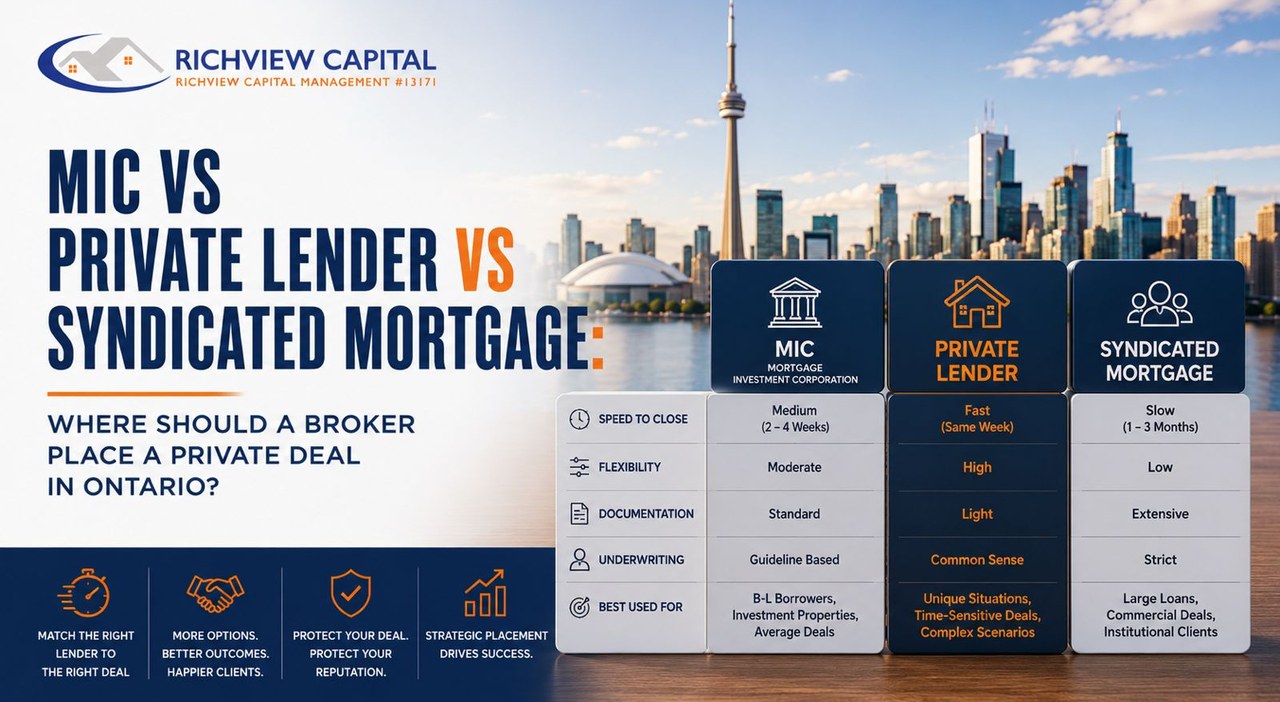
You have a file the banks will not touch. The client is real, the equity is real, and the deal makes sense on paper. Now comes the decision that determines how this file ends: where do you place it? For Ontario brokers, the MIC vs private lender difference matters more on broker deals than most comparison articles admit, because choosing between a mortgage investment corporation, an individual private investor, and a syndicated mortgage decides who funds the deal, who renews it, and who picks up the phone when payments stop.
Private lending is not a niche corner of your pipeline anymore. FSRA's Private Residential Mortgage Lending in Ontario Report 2024 counted $32.0 billion in private mortgage originations across 65,233 mortgages in 2024, about 12.5 percent of all mortgage dollars registered in the province, and in the GTA private lenders funded 17.3 percent of mortgages by count. If you work alternative files in Toronto or the 905, you are already choosing between these three structures on every placement.
This guide compares the three structures on the factors a placement decision turns on: reliability of funds, renewals, compliance and regulatory standing, service consistency, and what happens when a deal goes sideways. It is written for brokers and agents, not investors.
The Three Ways to Fund a Private Deal in Ontario
Be precise about what each structure is, because the differences drive everything downstream.
Individual private investor
One person (sometimes a couple or a holdco) lends their own money on a single mortgage, registered in their name. Your brokerage typically sources the investor and arranges the deal, with administration handled in-house or by a third party. FSRA's 2024 data shows individual lenders funded 22,761 Ontario mortgages worth $13.2 billion, so this remains a huge channel, especially for smaller seconds. The defining feature: one balance sheet, one decision-maker, one temperament.
Syndicated mortgage
Two or more investors jointly fund a single mortgage, each holding a direct interest in that one loan. Ontario splits these into qualified syndicated mortgages (simple residential deals meeting strict criteria, including a maximum 90 percent loan-to-value) and non-qualified syndicated mortgages, the complex, higher-risk variety regulators overhauled after high-profile failures. More on that history below. The defining feature: several investors tied to one asset, with no diversification for any of them.
Mortgage investment corporation (MIC)
A MIC pools capital from many shareholders into a professionally managed lending portfolio. The structure is defined in section 130.1 of the federal Income Tax Act: at least 20 shareholders, income flowed through to investors, and a portfolio weighted to residential mortgages and cash. For a broker, the practical effect is that you are dealing with a lending business, not a person: standing capital, written guidelines, and staff whose job is underwriting and servicing. Richview's explainer on how a mortgage investment corporation works covers the mechanics.
The defining feature: pooled capital deployed through a repeatable underwriting process. CMHC's Residential Mortgage Industry Report has tracked mortgage investment entities growing faster than the overall mortgage market for years, which tells you where broker volume has been migrating.
Side by Side: How the Three Structures Compare for Broker Deals
| Placement factor | Individual private investor | Syndicated mortgage | MIC |
|---|---|---|---|
| Source of funds | One person's capital | Several investors, raised per deal | Pooled corporate capital, already raised |
| Funding reliability | Depends on one person's liquidity and mood | Depends on filling the syndicate before closing | Committed from the pool once approved |
| Renewal behaviour | Tied to the investor's life and cash needs | Requires investor re-consent, per deal | Portfolio decision under written guidelines |
| Compliance profile | Suitability duty owed to the investor you sourced | Heaviest: layered FSRA/OSC rules by product type | You deal with a regulated lending entity, not a retail investor |
| Servicing | Varies with the individual or their administrator | Administrator coordinating multiple stakeholders | In-house or established servicing operation |
| Default handling | Emotional, unpredictable, sometimes litigious | Slowed by multi-investor coordination | Standardized arrears process |
| Best fit | Small, quirky deals with a known investor | Large single assets beyond one lender's capacity | Repeatable placement channel for alternative files |
The table is the summary. The next sections are the reasoning.
Reliability of Funds: Who Actually Closes?
Every broker who has worked private deals for a decade has a version of the same story: the individual investor who was liquid in January and fully deployed in March, or who read a headline and pulled back the morning of closing. That does not make individuals bad lenders. It makes them one balance sheet, with moods, vacations, and competing uses for the same money.
Syndication has a different failure mode: the deal closes only if the syndicate fills. If one participant drops out at commitment, you are re-raising capital against a closing date, and your client's purchase or refinance is the hostage.
A MIC funds from capital that is already pooled. Once a file clears underwriting and the commitment is issued, the money is not contingent on any one investor's circumstances. The honest trade-off: pooled capital comes with underwriting discipline, so a MIC declines files a motivated individual might fund on gut feel. Brokers who work with MICs learn to pre-screen against the guidelines, and a good starting point is understanding current private mortgage rates in Ontario so pricing expectations are set before submission.
Market context makes reliability worth more in 2026. The Bank of Canada has held its policy rate at 2.25 percent since June 2026, and cheaper money has pulled easier borrowers back to the banks. The files left in the private space are harder: bruised credit, stated income, tight timelines. They cannot absorb a funding failure. A February 2026 survey of Canadian mortgage brokers found brokers rank fast approvals, flexible policies, and competitive pricing as equally critical, and that most private lenders deliver on one while failing on the others.
Renewals: The 12-Month Question
Most private mortgages in Ontario run one-year interest-only terms, so every placement is really two decisions: who funds it now, and who sits across the table in 12 months.
With an individual investor, renewal depends on that person's life. A divorce, a retirement, a health event, or simple fatigue with the file can turn a routine renewal into a payout demand. Your client, who may not yet qualify back at a bank, is suddenly shopping for a replacement mortgage under deadline, and you are doing unpaid rescue work on a deal you already earned once.
With a syndicate, renewal needs each investor to re-commit. One dissenting participant can force a payout or a restructuring, and coordinating consent through the administrator takes time your client may not have.
A MIC treats renewal as a portfolio decision. If the loan has performed and the file still fits guidelines, renewal is the ordinary outcome. No credible MIC guarantees renewal, and none should: a deteriorated file gets a different answer. But the decision is made by an underwriting team applying consistent criteria, not by whether an individual needs their capital back for a kitchen renovation.
For a broker, the difference compounds. A book of individual-investor placements generates surprise payout events forever. A book placed with one or two well-run MICs behaves like a book, and renewals become repeat touchpoints instead of emergencies.
Compliance and Regulatory Standing
Your licence and your suitability duty
Placing private mortgages in Ontario is licensed activity with teeth. Since April 2023, arranging deals with private lenders, including MICs, individuals, and syndicates, requires a mortgage agent level 2 or broker licence under FSRA's mortgage brokering framework, and FSRA's 2025-26 supervision plan keeps private lending conduct squarely in its inspection priorities. When you place a deal with an individual investor you sourced, you owe suitability and disclosure obligations to that investor as well as to the borrower, and every file needs documented rationale for why this mortgage suited this investor.
Place the same deal with a MIC and the compliance geometry changes. You are submitting to a regulated lending entity that makes its own credit decision. Your duties to your borrower remain what they were, but you are no longer the person who decided an Etobicoke retiree should hold a third mortgage on a rural property.
The syndicated mortgage overhaul, and why it happened
Syndicated mortgages carry the heaviest regulatory history in this comparison. After years of scandals, Ontario restructured the rules: tightened requirements took effect in 2018, and in July 2021 oversight of non-qualified syndicated mortgages sold to retail investors moved to the Ontario Securities Commission, with FSRA retaining qualified syndications and non-qualified deals involving permitted clients. Brokerages handling non-qualified syndications face expanded disclosure, mandatory suitability forms, and investment caps for non-designated investors.
The reason is not abstract. CBC reported estimates of roughly $1 billion of Ontario investors' money lost in syndicated mortgage failures, and the collapse of Fortress-linked projects ultimately produced criminal fraud convictions for the developers behind the largest of them. Brokers who fed those deals paid with licences, fines, and reputations. Syndication remains legal, particularly qualified syndications on straightforward residential security, but it demands more compliance work per deal than either alternative, and regulators read those files closely.
A MIC, by contrast, sits on the other side of the regulatory line that matters to you: it is the lender, and it handles its own securities-law obligations to its shareholders. Your file is a lending transaction, not a distribution of an investment product.
Service Consistency After Closing
Brokers grade lenders on the road to closing and forget the two years after it. Your client will not. Every slow payout statement, misapplied payment, or stalled discharge becomes a call to your office, because you recommended the lender.
With an individual investor, service quality is whoever that person is. Some are meticulous; some winter in Florida and answer discharge requests when they get around to it. Syndicated deals add coordination cost: an administrator reporting to several stakeholders, any of whom can slow a consent.
A MIC services loans as a core operation: standing processes for payments, statements, renewals, and discharges, with staff accountable for turnaround. This is mundane until the day your client needs a payout statement to close a sale in 48 hours. Consistent servicing also matters commercially, since second mortgage placements and short-term files churn quickly and generate constant administrative touches.
When the Deal Goes Sideways
Suppose a broker has a client who takes a $150,000 second mortgage on a Scarborough semi, then loses a contract job in month five and misses payments in months six and seven. Same borrower, same property. What happens next depends entirely on which structure holds the mortgage.
Individual investor. This is often the moment a first-time private lender discovers what enforcement involves. Reactions run from paralysis to panic: some push straight to legal action, others let arrears compound to avoid confrontation. Either way the response is improvised, and the broker gets dragged in as mediator, translator, and target.
Syndicated mortgage. Enforcement needs alignment among investors with different risk tolerances. One wants to negotiate, one wants immediate power of sale, one has stopped answering the administrator. Delay is structural, and delay in arrears burns your client's remaining equity.
MIC. A workout follows a process the lender has run before: early contact, an arrears arrangement if the setback is genuinely temporary, and, where it is not, enforcement under Ontario's power of sale regime handled by counsel who does this routinely. Process does not make default painless, and no broker should promise leniency. But a predictable, documented response protects equity better than improvisation, and it keeps you out of the middle.
The scenario is common enough to plan for. FSRA reports non-bank mortgage delinquency reached 0.20 percent by Q3 2024, with mortgage investment entities at 1.22 percent, as the private book skews toward harder files. Placing a deal with a lender that has a real arrears process is risk management for your client and your own E&O exposure.
Where Each Option Still Makes Sense
An honest comparison ends with fit, not a coronation.
- Individual private investor: small deals, unusual collateral a fund will not hold, or a long-standing investor relationship with genuinely fast, informal decisions. Accept the renewal and servicing volatility as the price.
- Syndicated mortgage: a large single asset beyond one lender's appetite, ideally a qualified syndication on residential security, with the compliance workload priced into your economics.
- MIC: the default channel for repeatable alternative business: equity takeouts, bridges, debt consolidation seconds, bruised-credit refinances.
Whichever way you place a file, vet the lender like your licence depends on it, because it does. Confirm licensing status, ask how the lender funded its last twenty deals, ask who services the book, and get the arrears process in writing. Then package the submission properly; our guide to submitting a private mortgage deal in Ontario walks through what a fundable file looks like before it hits an underwriter's desk.
FAQ
What is the main difference between a MIC and an individual private lender for a broker's deal?
An individual lends one person's money on one mortgage, so funding, renewal, and default handling all depend on that person's circumstances. A MIC lends pooled capital through a managed portfolio with written guidelines, which makes commitments, renewals, and servicing far more predictable for the broker and the borrower.
Do I need a special licence to place private mortgages in Ontario?
Yes. Since April 2023, arranging mortgages with private lenders, including MICs, individual investors, and syndicates, requires a mortgage agent level 2 or mortgage broker licence under FSRA's framework. Level 1 agents may only deal with financial institutions and other approved lenders.
Are syndicated mortgages still legal in Ontario?
Yes, but they are more heavily regulated than before. Qualified syndicated mortgages remain under FSRA, while non-qualified syndicated mortgages sold to retail investors moved to Ontario Securities Commission oversight in July 2021 after large investor losses. Brokers face expanded disclosure, suitability, and documentation requirements on these deals.
What happens at renewal when the lender is a MIC versus an individual?
A MIC treats renewal as a portfolio decision: a performing loan that still fits guidelines is normally renewed through a standard process, though no lender guarantees it. An individual investor's renewal depends on personal circumstances, so a divorce, retirement, or cash need can force a payout demand even on a perfectly performing mortgage.
How should a broker vet a MIC before sending a file?
Confirm the MIC's licensing status with FSRA, review its lending guidelines so you can pre-screen files, and ask about funding sources, servicing, and its written arrears process. A direct lender with in-house underwriting should answer all of this quickly and put its commitment terms in writing.
Sending Your Next Private File to a Direct MIC Lender
Structure predicts behaviour, so build your private channel around a lender whose structure works in your favour: a well-run MIC as the first call on alternative files, with individuals and syndication reserved for deals that genuinely need them.
Richview Capital is a licensed Ontario mortgage investment corporation (MIC #13171) lending across Toronto, the GTA, and Ontario. As a direct MIC lender with in-house underwriting, Richview works through the broker channel: you deal with the people making the credit decision, commitments are funded from pooled capital, and the same team services the file after closing. Expect straight answers on whether a file fits, clear commitment terms, and a lender that treats renewals and workouts as process, not improvisation.
If you have a deal looking for a home, or want to understand Richview's lending criteria before the next declined file arrives, connect through the Richview Capital brokers page.
Next steps: Brokers · Submit a Deal · FAQ
Richview Capital MIC is a licensed Mortgage Investment Corporation (Mortgage Administrator License #13171). This article is educational information for Ontario mortgage brokers, not legal, financial, or tax advice. Rates, fees, LTV limits, and approvals vary by file and underwriting, and published ranges are subject to change and are not an offer of credit.