Where to Place Declined Mortgage Deals in Ontario: A Broker's Decision Tree
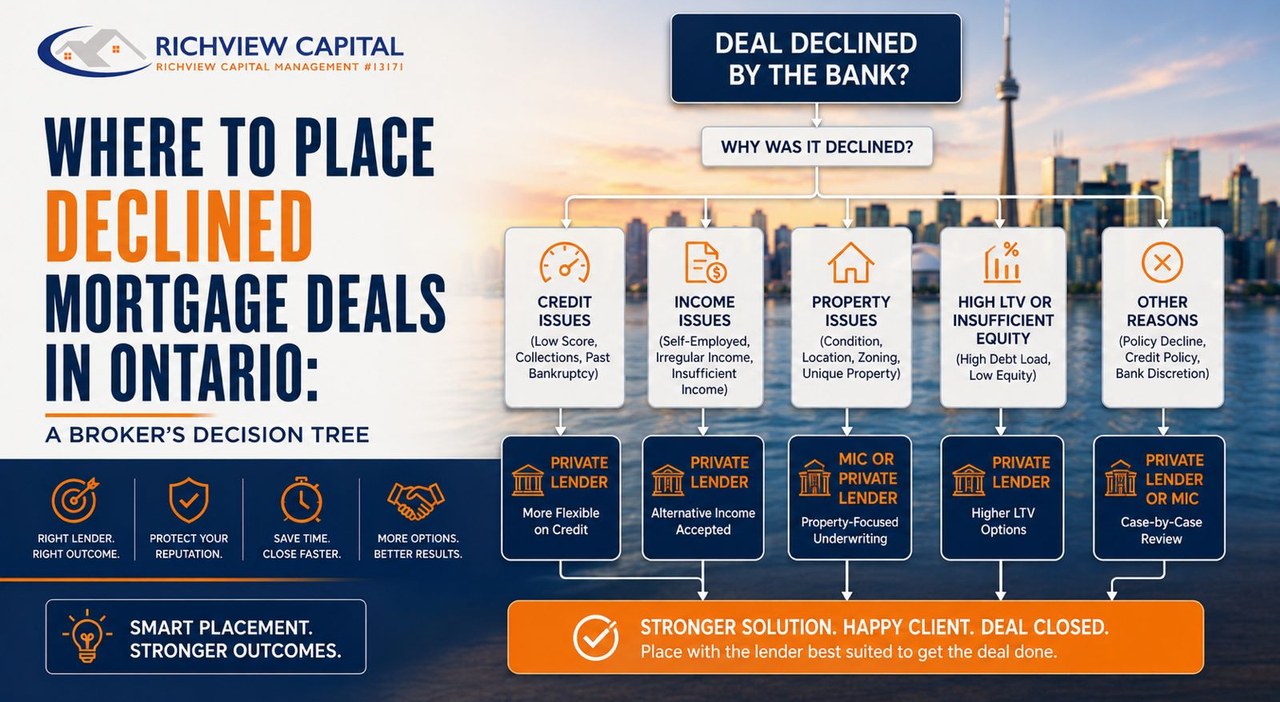
You do not have a "declined file" problem. You have a "declined for what" problem. Where to place declined mortgage deals in Ontario, whether with a B lender, a MIC, or an individual private lender, comes down almost entirely to the reason on the decline, and brokers who triage by reason place files faster, avoid wasted submissions, and keep clients from walking. Treat every decline as one generic bucket and you will send ratio problems to equity lenders, credit problems to B lenders who will bounce them, and burn a week you did not have.
This is a placement guide for Ontario brokers and agents, not a borrower explainer. Five branches, one call at the end of each: B still works, or it is a MIC or private deal. Then the part most guides skip, which is how to reset the client's expectations so the file actually closes.
Read the decline reason first, then pick the tier
Quick alignment on what each tier actually underwrites, because the tiers are not interchangeable.
B lenders (Home Trust, Equitable, credit unions, and similar) are still income-and-credit lenders. They flex the inputs: higher debt service ratios, bank-statement income programs, lower credit floors, and in many cases more forgiving qualifying math than the A side. Under OSFI's B-20 guideline, federally regulated lenders qualify uninsured mortgages at the minimum qualifying rate: the greater of the contract rate plus 2% or 5.25%. With the Bank of Canada's policy rate at 2.25% as of August 2026, plenty of borrowers carry contract rates that push the stress test well above 7%, which is exactly why files that are fine on real-world cash flow still fail A-side math. Note that OSFI now exempts straight switches at renewal (same amount, same amortization) from the MQR, which quietly rescues some renewal files before they ever become placement files.
MICs (mortgage investment corporations) are pooled, managed lending funds. They lend primarily on the security: equity, marketability, location, and a credible exit. Ratios and bruised credit matter far less. Because a MIC underwrites in-house against a fund mandate, decisions are consistent and fast, and the money is already raised. If a MIC is new territory for you, here is how a mortgage investment corporation works from the lender's side.
Individual private lenders underwrite the same way a MIC does, but with one person's capital, one person's risk appetite, and one person's availability. They can be the right answer for genuinely odd files a fund mandate excludes, and the wrong answer when the client needs certainty of closing.
One compliance line before the branches, because it decides who can even work the file: since April 1, 2023, FSRA requires a Mortgage Agent Level 2 or broker licence to arrange mortgages with private lenders, including MICs. A Level 1 agent can place the B branch of this tree, not the private branches.
Branch 1: Declined on GDS/TDS
When B still works
Ratio declines are the most recoverable decline there is. A lenders generally hold to 39/44 GDS/TDS. Most B lenders will run to roughly 50/50, some use the contract rate rather than a stress-tested rate on certain products, and rental offsets and part-time or contract income get treated more generously. If the client's ratios land under about 50/50 at B math, with a credit score the lender can live with, this is a B deal. Do not reprice it as private; you will lose the client to the next broker who runs the numbers properly.
Also check the cheap structural fixes before escalating: extend amortization, add a documented co-borrower, or split the request into a smaller first plus a second mortgage so the A or B first survives.
When it is a MIC or private deal
Escalate when the debt service is not there under any income the client can paper, or when the ratios are a symptom of something else, usually consumer debt that needs to be consolidated before any institutional lender will touch the file. Suppose a broker has a client with $110,000 of unsecured debt, a GDS/TDS of 55/68, and a Toronto semi with 45% equity. No B lender takes that TDS. A one-year equity loan that consolidates the debt, drops the monthly outflow, and sets up a B refinance in 12 months is the placement. That is a MIC file, and the exit is the whole underwrite.
Branch 2: Declined on credit
When B still works
B lenders buy credit stories, not just scores. A score in the low 600s with a documented one-time event (divorce, illness, a business interruption) and clean recent conduct is squarely B. Past lates that are cured, high utilization that a consolidation will fix at closing, thin bureaus with strong income: all placeable at B, sometimes with a rate premium and a fee.
When it is a MIC or private deal
Active consumer proposals, proposals discharged less than a year or two ago, recent write-offs or judgments, scores below the mid-500s, or a bureau that is still deteriorating: this is equity lending territory. The context matters in 2026. Equifax Canada's Q2 2026 Market Pulse reports that 90+ day non-mortgage delinquency among Ontario mortgage holders hit 0.86%, up 27% year over year and above the national 0.77%, and that 90+ day missed mortgage payments in Ontario have risen every quarter for four years. More bruised-credit files are coming through every broker's door, and the ones with real equity are placeable. The underwriting question stops being "what happened to the credit" and becomes "what is the property, what is the equity, and what is the exit."
Branch 3: Declined on income documentation
When B still works
Self-employed clients with two years of filed returns, or 6 to 12 months of business bank statements supporting stated income, usually fit a B program. Add-backs, dividend income, and reasonable gross-up treatment give B underwriters room the A side does not have. Commissioned income with a short history often lands here too. If the income exists and can be papered any credible way, exhaust B first. We cover the doc packages that work in our piece on self-employed mortgage options in the GTA.
When it is a MIC or private deal
When the income cannot be papered at all, the file is private by definition: a cash-heavy business with statements that will not support the stated figure, a newcomer with strong assets but no Canadian income history, a client between contracts, or income that is real but arrives lumpy (builders, realtors, incorporated consultants who leave everything in the company). An equity lender is not pricing the income; it is pricing the property and the plan. That is not a workaround, it is a different product, and it should be presented to the client as such.
Branch 4: Declined on the property
This branch skips B more often than any other. Institutional credit boxes decline properties regardless of how strong the borrower is: large acreage and rural properties outside serviced areas, mixed-use and live-work buildings, homes mid-renovation or in un-mortgageable condition, raw or serviced land, unique builds, and some small or aging condo stock. The borrower's ratios never enter the conversation.
For these, go straight to equity lenders and lead your submission with the property: location, marketability, realistic as-is value, days-on-market for comparables, and what the money does (purchase, completion of work, bridge to sale). A GTA mixed-use property with a strong commercial strip location is an easy conversation with the right MIC; the same building in a thin rural market may only work at a lower loan-to-value or with an individual private who knows the area. Property-type deals are where lender selection inside the private tier matters most, so ask the lender what their mandate excludes before you submit, not after.
Branch 5: Arrears, CRA debt, and power of sale
These are the files where speed is the underwriting. Mortgage arrears, property tax arrears, CRA liens, or an active power of sale make the file untouchable at A and B until cured, and the cure is exactly what the private loan is for: pay out the defaulted first or the arrears, stop enforcement, and give the client 12 months to sell or refinance in an orderly way.
The volume is real. CMHC and Equifax data reported by CP24 show GTA mortgage arrears roughly quadrupled between Q3 2022 and Q3 2025, from about 662 to nearly 2,800 consumers, with pandemic-era buyers renewing from record-low rates under the most strain. The GTA arrears rate is still low in absolute terms at 0.26%, but the direction has been one way for three years.
Placement notes for this branch: get the payout statement and enforcement correspondence into the package on day one, verify property taxes yourself, and size the request to include arrears, penalties, legal costs, and, where the debt service is not there, an interest reserve or prepaid interest so the loan performs while the client executes the exit. A direct lender with in-house underwriting matters most here, because a power of sale timeline does not wait for a lender to syndicate funds.
The one-page decision tree for declined deals
| Decline reason | B lender still works when | MIC or private when |
|---|---|---|
| GDS/TDS | Ratios fit under roughly 50/50 at B math; income is documented; structural fixes (amortization, co-borrower, second mortgage) close the gap | Debt service fails under any documented income; heavy consolidation needed first; bridge situations |
| Credit | Low 600s with a cured, documented story; clean recent conduct | Active or recent consumer proposal, recent write-offs, mid-500s or below, deteriorating bureau |
| Income docs | Income can be papered via returns, bank statements, or stated programs | Income cannot be credibly papered; newcomer without history; cash-heavy business |
| Property type | Rarely; institutional boxes are rigid on property | Rural, mixed-use, land, condition issues, unique builds; underwrite the property, pick the lender by mandate |
| Arrears / CRA / power of sale | Only after cured | Almost always; speed and payout math drive the file; build in the exit |
Setting client expectations (and keeping the deal)
The placement call is half the job. The other half is a five-minute conversation that determines whether the client closes with you or shops the rate you just quoted.
Price the tier, not the dream. In the current Ontario market, private and MIC money on residential files generally runs high single digits to low double digits on firsts and higher on seconds, plus a lender fee and a broker fee typically in the 1% to 2% range each. Give the client the range before any lender is named, anchored to what the money fixes. Our current numbers and how they are built are here: private mortgage rates in Ontario.
Sell the exit, not the rate. Suppose a broker has a client facing a power of sale with a $520,000 first in arrears on a home worth $850,000. A one-year private first of $560,000 covering payout, arrears, and costs is roughly 66% loan-to-value. At an illustrative 10% interest-only, carrying it costs about $4,667 a month for 12 months, against losing the property and the equity in a forced sale. Framed that way, the rate is not the story; the preserved equity is. Every private placement should be presented with this structure: what it costs for how long, and exactly how the client gets out (B refinance after 12 months of clean payments, sale by a set date, or completion of the income story). If you cannot articulate the exit, the lender will decline it for the same reason.
Do the compliance properly. Private placements in Ontario carry enhanced suitability and disclosure obligations, including the Form 1 / 1.1 disclosure to the investor or lender and documented suitability for the borrower. FSRA has been explicit that private deals get regulatory attention, which is a reason to write better files, not to avoid the space. A clean package also gets faster answers; here is how to package and submit a private mortgage deal in Ontario step by step.
FAQ
Can a Level 1 agent place a private mortgage in Ontario?
No. Since April 1, 2023, FSRA requires a Mortgage Agent Level 2 or full broker licence to arrange mortgages with private lenders, including MICs. A Level 1 agent can work the B lender branch or hand the private branch to a Level 2 colleague under their brokerage.
Should I always try a B lender before going private?
No, and the decision tree is the reason. Ratio, credit, and income-doc declines that fit B parameters should go to B first because the client's cost of funds is lower. Property-type declines, arrears, power of sale, and unpaperable-income files should go straight to an equity lender, because a B submission wastes days and sometimes a credit pull on a file B cannot take.
What is the difference between a MIC and an individual private lender?
A MIC is a pooled fund with a mandate, in-house underwriting, and capital already raised, which generally means consistent criteria and reliable closings. An individual private lender is one person's capital and discretion, which can accommodate unusual files but adds funding and timeline risk. For time-sensitive files, certainty of closing usually favours a direct MIC.
What loan-to-value should I expect on a private deal in the GTA?
Most Ontario equity lenders hold residential files to roughly 75% LTV or below, with tighter caps on condos, rural properties, and second positions. The realistic as-is value, not the purchase price or the client's estimate, drives the number, so support your value with comparables in the submission.
How do I protect the client and myself on the exit?
Underwrite the exit before you submit: a B refinance the numbers actually support in 12 months, a listing plan with a realistic price, or a documented income event. Put the exit in writing in your suitability notes, revisit the file 60 to 90 days before maturity, and avoid stacking renewals with no plan, which is where private files and E&O claims go wrong.
Where Richview Capital fits in your placement stack
Once the tree says MIC, the next question is which one. Richview Capital is a licensed Ontario mortgage investment corporation (MIC #13171) lending its own fund's capital across Toronto, the GTA, and Ontario, with underwriting done in-house and deals sourced through the broker channel. Because we are a direct lender rather than a syndicator, the person reviewing your file is the person who can approve it, and you deal with one credit decision, not a search for capital.
For brokers, that means straight answers on the branches this article covers: consolidation-driven ratio files, bruised credit with real equity, self-employed and unpaperable income, and time-sensitive arrears and power of sale payouts. Send the decline reason, the property, and the exit, and you will get a direct read on whether the file fits our mandate.
If you have a declined file on your desk now, or you want a MIC relationship in place before you need one, start at our broker portal and connect with our underwriting team.
Next steps: Brokers · Submit a Deal · FAQ
Richview Capital MIC is a licensed Mortgage Investment Corporation (Mortgage Administrator License #13171). This article is educational information for Ontario mortgage brokers, not legal, financial, or tax advice. Rates, fees, LTV limits, and approvals vary by file and underwriting, and published ranges are subject to change and are not an offer of credit.