Custom Home Construction Loans in Ontario: A 2026 Guide to Financing a GTA Knockdown Rebuild
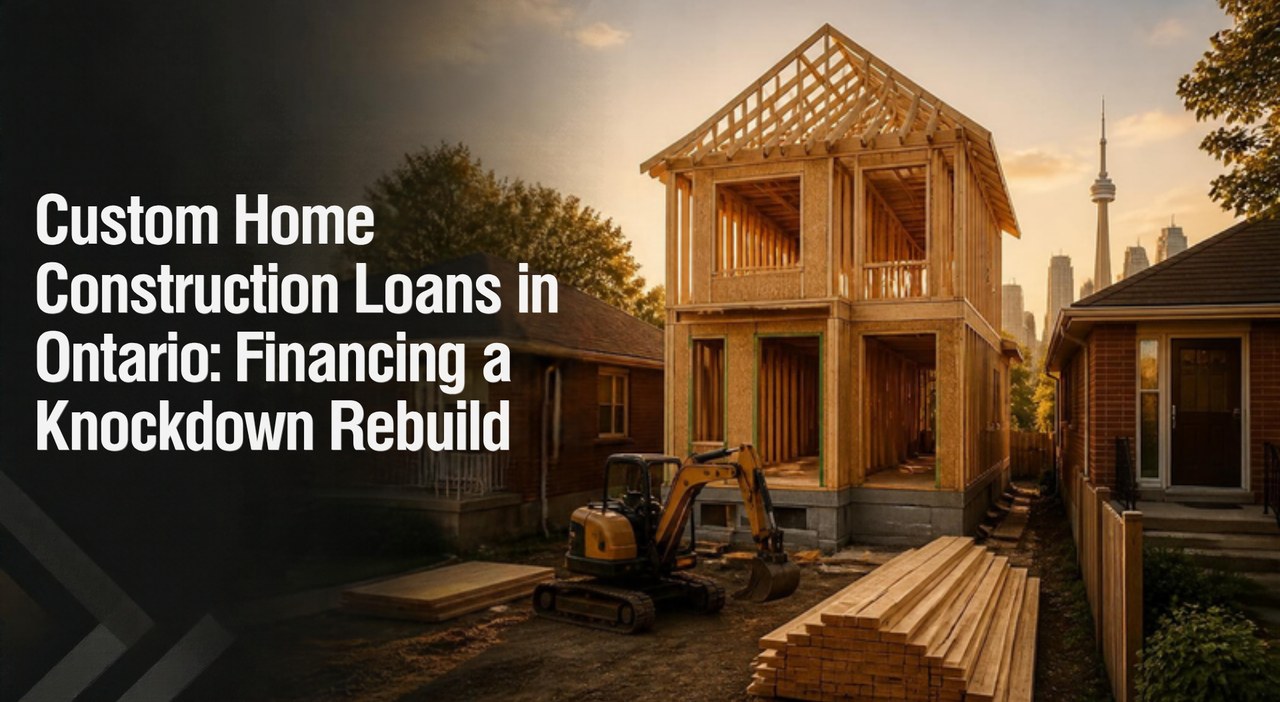
You own a tired bungalow on a good lot in Toronto, Mississauga, Oakville or Richmond Hill. The house is worth little, the land is worth a lot, and the plan is to tear it down and build the home you want. Then the financing question lands: your current mortgage was written against a house that will soon be a hole in the ground, and a normal mortgage does not pay for lumber, trades and permits as you go.
That gap is what a custom home construction loan fills: a mortgage that advances in stages as the build progresses. Whether a bank, credit union or private lender will offer one depends on who is building the house, how solid the budget is, what the finished home appraises at, and how the loan gets paid out at the end.
This guide explains how custom home construction loans work in Ontario in 2026, with GTA knockdown rebuilds in mind: self-build versus licensed builder (and what HCRA and Tarion require), budgets, as-complete appraisals, bank declines and private lenders, and conversion at completion. It is written for homeowners and the Ontario mortgage agents and brokers who place these files. For how each advance is verified, see our guide to the construction draw schedule in Ontario.
How a Custom Home Construction Loan Works in Ontario
A construction loan is still a mortgage registered on title. The difference is in how the money comes out and how the lender measures risk.
Progress advances, not a lump sum
Funds are released in stages after an inspector or appraiser confirms work is complete, from foundation through framing, rough-ins, drywall and final completion. On a knockdown, the first advance often pays out the existing mortgage. Each later advance pays for work already in place, so someone has to fund work before being reimbursed. Draw stages are covered in our construction draw schedule guide; this article focuses on how the overall loan is sized and approved.
Interest during the build
Interest is normally charged only on the amount advanced, so carrying costs climb as the balance grows. Many lenders require interest-only payments during construction, and private lenders often hold back an interest reserve so payments come out of the loan.
The 10% holdback
Ontario's Construction Act requires owners to hold back 10% of payments to contractors to protect subcontractors and suppliers with lien rights, and lenders build this into advances. According to a 2026 homeowner guide from Nihang Law, amendments that came into force on January 1, 2026 made annual holdback release mandatory on longer projects, while the basic lien deadlines (60 days to preserve a lien, with a further 90 days to perfect it) did not change. The last 10% of contractor payments often waits on the lien period, which can affect the timing of the final advance and any refinance.
Knockdown Rebuild Financing in Toronto: What Changes When the House Comes Down
Building on a vacant lot and rebuilding on your own lot are financed the same basic way, but a knockdown adds three issues that lenders ask about early.
Your existing mortgage and the value of the lot
Once the old house is demolished, the security behind your current mortgage drops to the value of the land, so most lenders want the existing mortgage paid out or folded into the construction loan first. In much of the GTA, the lot's as-is value is the biggest source of equity in the project, which is why owners of older homes on large lots are often in a stronger position than they expect.
Toronto's demolition permit conditions
In Toronto, demolition of a residential building with fewer than six units is governed by Chapter 363 of the Toronto Municipal Code. Where a building permit has already been issued for the replacement home, the demolition permit carries conditions: the new building must be substantially complete within two years of the day demolition begins, and if it is not, the City may add $20,000 per dwelling unit to the tax roll as a charge on the land. Where no replacement permit has been issued, the application goes to community council instead. Lenders care because a stalled build can create a municipal charge on title. Other GTA municipalities have their own demolition rules, so check with the local building department.
Where you live during the build
A knockdown means paying rent elsewhere while carrying the construction loan, and lenders count that cost in affordability. Plan for twelve to eighteen months of alternate housing.
Self-Build vs Hiring a Builder: What HCRA and Tarion Require
This decision most affects which lenders will look at the file. The rules below come from the regulators' own guidance.
Hiring a licensed builder for a contract home
If you hire a builder to construct a custom home on land you already own, Ontario treats it as a "contract home." The Home Construction Regulatory Authority (HCRA) says a builder constructing a contract or custom home on the owner's land must be licensed as a vendor and builder, and that buyers should confirm the home is approved by Tarion and enrolled in the warranty plan before signing. It is illegal to build or sell a new home in Ontario without a valid licence.
Enrolment brings statutory protection. Tarion's warranty information sheet for contract homes describes deposit protection of up to $40,000 on money paid to the builder under the construction contract, plus one-year, two-year and seven-year warranty coverage (the seven-year coverage applies to major structural defects), with total coverage capped at $400,000. The HCRA's Ontario Builder Directory shows a builder's licence status and history.
Building as an owner-builder
If you manage the project yourself and hire the trades directly, you are an owner-builder. HCRA guidance says a person building on land they own may not need a builder's licence, provided they do not sell the home after construction. The trade-off is significant: HCRA states that an owner-built home is not eligible for warranty coverage under the Ontario New Home Warranties Plan Act. You also take on the builder's responsibilities, from permits to workplace safety to every trade contract.
Some municipalities make this explicit at permit time. Guelph's owner-built home acknowledgement form, for example, has the owner confirm there is no warranty coverage and that the home is not being built to sell.
The line between owner-builder and builder is not always obvious. A Miller Thomson analysis notes it turns on who controls the project, including who obtained permits and how contracts allocate responsibility. If you are hiring a "construction manager," get legal advice on which side you sit.
How lenders view each path
| Factor | Licensed builder (contract home) | Owner-builder |
|---|---|---|
| HCRA licence | Builder must be licensed | Not required if you do not sell after construction |
| Tarion enrolment and warranty | Required; 1, 2 and 7-year coverage | Not eligible for statutory warranty |
| Deposit protection | Up to $40,000 under the contract | None |
| Lender comfort | Higher; fixed-price contract and builder track record help | Lower; many banks want proof of building experience or decline |
| Budget risk | Shifts partly to the builder under a fixed-price contract | Sits fully with the owner |
| Paperwork lenders ask for | Signed contract, licence, enrolment, budget, plans, permit | Detailed cost breakdown, trade quotes, schedule, experience, permit |
Building a Budget and Contingency a Lender Will Accept
Lenders want a costed budget that an appraiser or quantity surveyor can check, and they advance only while the cost to complete stays covered.
Hard costs, soft costs and site costs
Hard costs are the building itself, from foundation to finishes. Soft costs are what it takes to get permission and money: design and engineering, surveys, permits, legal, builder's risk insurance, appraisals, inspections, and lender and broker fees. Site costs on a knockdown include demolition, utility disconnects and reconnects, tree protection, excavation and grading. Ask the municipality early whether development charges apply or are offset by a credit for the demolished home.
Contingency and interest reserve
A contingency is a cash buffer for poor soil, a plans examiner's changes or a price jump on windows. A common working range is 10% to 15% of hard and site costs, toward the top for owner-builders and older lots. Lenders want it inside the budget, plus a separate interest reserve so loan payments do not compete with trade invoices.
Rebates that can change your net cost
Owner-built homes can qualify for GST/HST new housing rebates, and Ontario added a temporary enhancement in 2026. According to the CRA notice on the Ontario Enhanced New Housing Rebate, owner-built homes are eligible where construction begins between April 1, 2026 and March 31, 2027, the home is substantially completed before 2030, and its fair market value at substantial completion is under $1,850,000. Many GTA knockdowns will be worth more, so confirm eligibility with an accountant, and do not expect a lender to count a rebate as equity.
Appraisals: As-Is Land Value vs As-Complete Value
The appraisal decides how much you can borrow, and on a construction file the lender typically needs two values.
How lenders size the loan
The appraiser values the property as it stands (the as-is value, mostly land on a knockdown) and as it will be when finished to plan (the as-complete value). Many institutional lenders lend a percentage of the lower of two figures: the as-complete value, or the as-is value plus the cost of the build. CMHC uses the same logic for its insured improvement financing, defining lending value as the lesser of the as-improved value or the as-is value plus improvement costs. CMHC's insured programs cap the purchase price or lending value at $1,500,000, so most GTA custom builds are financed as conventional, uninsured mortgages with at least 20% equity.
Private lenders more often lend a percentage of the as-complete value, with that percentage set conservatively to account for construction risk.
When the appraisal comes in low
A low as-complete value usually means the design is ahead of what the street supports. Challenge the comparables with better evidence, trim the scope, add cash, or move to a lender whose formula fits the gap. Do not hope the market catches up during the build.
Worked Example: One Toronto Knockdown, Two Lenders
All figures below are hypothetical, chosen to show the math, and do not reflect any lender's policy or pricing.
Suppose a homeowner in Toronto owns a 1950s bungalow on a 50-foot lot. The appraiser puts the as-is value at $1,500,000 and the as-complete value of the planned home at $3,100,000. The existing mortgage balance is $700,000. The homeowner plans to act as owner-builder, hiring trades directly.
| Budget line (hypothetical) | Amount |
|---|---|
| Demolition and site work | $60,000 |
| Hard costs | $1,040,000 |
| Soft costs (design, permits, surveys, insurance, legal, fees) | $140,000 |
| Contingency (10% of hard and site costs) | $110,000 |
| Total build cost | $1,350,000 |
| Total project cost (as-is value plus build) | $2,850,000 |
Example: a bank construction mortgage. Suppose the bank lends up to 80% of the lesser of total project cost ($2,850,000) and as-complete value ($3,100,000). That is $2,280,000. After the $700,000 payout, $1,580,000 is available, which covers the build. The file still fails, because this bank requires a licensed builder or proven building experience.
Example: a private construction lender. Suppose a private lender offers 65% of as-complete value, or $2,015,000. After the $700,000 payout and, say, $120,000 set aside for lender and broker fees and an interest reserve, $1,195,000 is left for the build. That is $155,000 short of budget, so the homeowner puts that cash in, usually before the first construction advance.
Example: the exit. At completion, the home appraises at $3,100,000 and has its final municipal inspection. The owner-builder concern is gone, because the bank is now lending on a finished house. The homeowner refinances about $2,050,000 (roughly 66% loan-to-value), pays out the private lender, and qualifies at the stress-test rate. A lower completed value or a drop in income would put that exit in doubt, which is why both lenders test it up front.
When Banks Say No and Private Construction Lenders Step In
Common reasons for a decline
Banks and credit unions decline custom builds for predictable reasons. The borrower is an owner-builder without a track record. Household income does not qualify at the stress-test rate: for uninsured mortgages, OSFI's minimum qualifying rate is the greater of the contract rate plus 2% or 5.25%, and it applies to the full construction balance. Self-employed income is recently variable, or the design is unusual enough that comparables are thin.
How private construction lenders work
Private lenders and mortgage investment corporations focus on the property, budget and exit rather than rigid income ratios. Their loans are short term, often 12 to 24 months, and cost more. Pricing is set by loan-to-value, position on title (first or second mortgage), term, and the risk profile of the project. An experienced builder with a permit and a fixed-price contract prices differently than a first-time owner-builder waiting on a variance. Expect lender and broker fees, your equity in first, cost-to-complete checks before every advance, and a written exit plan. See also private construction loans in Ontario and construction financing in Ontario for broader context.
What brokers need to document
Agents and brokers placing private mortgages must document suitability and disclose terms clearly. FSRA's review of private mortgage transactions found that roughly 65% had weak suitability documentation and criticized disclosures that simply said "see commitment." On a construction file, the suitability note should cover the budget, contingency, exit and a late-build scenario.
Converting to a Regular Mortgage at Completion
Bank construction mortgages
With many institutional lenders, the construction mortgage becomes a regular mortgage after a final inspection and final advance. Payments switch from interest-only to blended principal and interest on the agreed amortization. Confirm in the commitment whether the rate is set at the start or at the final advance.
Exiting a private construction loan
For a homeowner, a private construction loan almost always ends with a refinance. The new lender will want a completion appraisal, evidence of municipal final inspection or occupancy, proof that holdbacks have been handled and no liens are registered, an updated title search, and current income documents. Start the refinance two to three months before expected completion.
Typical sequence from first call to final mortgage
- Feasibility: lot survey, zoning review, any Committee of Adjustment variances, preliminary budget.
- Builder decision: licensed builder under a contract (with Tarion enrolment) or owner-builder.
- Plans, permit application and costed budget with contingency.
- Lender application, as-is and as-complete appraisal, commitment.
- Existing mortgage paid out; demolition permit and building permit in hand.
- Construction with staged inspections and advances, holdback retained.
- Final inspection, completion appraisal, lien period tracked.
- Final advance and conversion, or refinance out of the private loan.
Common Mistakes on GTA Custom Builds
- Demolishing before financing is committed. Once the house is gone, your options narrow.
- Treating contingency as optional. It is the usual reason builds stall at drywall.
- Assuming a bank will lend to an owner-builder. Ask the question directly before you pay for full drawings.
- Ignoring Toronto's two-year condition. A delayed build can trigger a municipal charge on title.
- Forgetting the holdback. The last 10% of contractor payments can delay the final advance and the refinance.
- Building above the street. Over-improving relative to comparables produces a low as-complete appraisal.
- No exit plan. A private loan without a credible refinance plan becomes a maturity-date problem.
FAQ
Can I get a custom home construction loan in Ontario as an owner-builder?
Yes, but fewer lenders offer it. Many banks require a licensed builder or proof of construction experience, while some credit unions and private lenders will consider owner-builders with a detailed budget, trade quotes and a strong contingency.
Does an owner-built home in Ontario come with a Tarion warranty?
No. HCRA guidance states that owner-built homes are not eligible for statutory warranty coverage under the Ontario New Home Warranties Plan Act. If you hire a licensed builder to build on your land, the home must be enrolled with Tarion and carries the 1, 2 and 7-year warranties.
How much equity do I need for a knockdown rebuild in the GTA?
It depends on the lender's formula and the appraisal. Conventional lenders commonly require at least 20% equity in total project cost, and private lenders lend a lower share of as-complete value, so many borrowers fund part of the build in cash.
What is an as-complete appraisal?
It is the appraiser's estimate of the property's value once the home is finished to the approved plans. Lenders use it with the as-is value and build cost to set the maximum loan.
Do I need to pay off my existing mortgage before demolition?
In most cases, yes. The construction lender will want first position on title, so the existing mortgage is usually paid out from the first advance before the old house comes down.
How long does a private construction loan last?
Terms are commonly 12 to 24 months, timed to cover construction plus a buffer for the refinance. Ask what extension terms apply if the build runs late.
What happens if my build goes over budget?
Lenders will only advance while the remaining loan covers the cost to complete, so overruns usually have to be funded with your own cash first. A realistic contingency is the main protection.
Before You Talk to a Lender About Your Build
Strong custom home construction loan files arrive with a recent survey and zoning review, permit drawings or a clear permit path, a costed budget with a real contingency, the builder's HCRA licence and Tarion enrolment details (or an honest account of your own building experience), mortgage statements, income documents, and a written exit plan.
With those ready, talk to a licensed Ontario mortgage agent or broker who works with both institutional and private construction lenders. They can tell you which lenders accept your builder arrangement, how the project is likely to appraise, and whether a bank construction mortgage or a private loan with a planned refinance fits better.
Next steps: Borrowers · Speak With Our Team · FAQ
Richview Capital MIC is a licensed Mortgage Investment Corporation (Mortgage Administrator License #13171). This article is educational information for Ontario homeowners, not legal, financial, or tax advice. Rates, fees, LTV limits, and approvals vary by file and underwriting, and published ranges are subject to change and are not an offer of credit.